Dr. Lily Chu The results of this survey were presented by Lily Chu at the FDA Drug Development Workshop for CFS and ME on April 25-26, 2013.
Preliminary Results – April 2013 FDA Workshop Survey
By Lily Chu, Leonard Jason, Madison Sunnquist, Suzanna So
Demographics: 85% of our subjects were female and almost all subjects were Caucasian. The average age was 51 and the average duration of illness was 18 years. For 50% of our respondents, this survey is the only way they are participating in this workshop.
Symptoms: The 5 most significant symptoms were fatigue, post-exertional malaise, pain, sleep, and cognitive problems. Symptoms that haven’t been studied as much such as multiple chemical sensitivities, gastrointestinal symptoms, and orthostatic intolerance were also deemed to be significant by over 50% of our subjects. 99% felt that their illness was not improving over time, citing worsening of existing symptoms and appearance of new symptoms.
Out of five objective tests we asked about, 66% had at least one abnormal result. For natural killer cell activity, for example, 70% noted an abnormal result. Tests like these could be used as study inclusion criteria, as outcome measures, and as a way to select subgroups for analysis. We believe that studying subgroups may help yield more effective treatments given the heterogenous nature of CFS.
Impact on Daily Life: Using a standardized measure of physical functioning, we found our respondents to be more disabled than 95% of the general US population. Only 13% were employed, with almost all citing ME and or CFS as the reason for why they could not work. For even basic personal care, 89% needed assistance or had to change their pre-illness routine. On their worst days, 60% were bedridden. On their best days, 75% could only do some light housework or less.
Perspectives on Current Treatment: 75% of people felt current treatments were not helpful or only slightly helpful but not enough to improve their day-to-day function. Patients repeatedly wrote about the need for disease-modifying treatments and not only for treatments that helped control symptoms.
We asked about how well currently recommended treatments worked for the illness overall and for three common symptoms: sleep, pain, and cognitive problems.
These treatments were cited as helpful by more than 50% of subjects:
- for the overall illness - balancing rest with activity, restricting or modifying physical/ mental activities
- for sleep – CPAP, over-the-counter medicines, zolpidem, eszoplicone, TCAs, trazodone, benzodiazepines
- for pain – short/ long-acting opioids, flexeril, ibuprofen
Some alternative/ complementary/ non-drug treatments also made the cut. Helpful prescription drugs cited in patient comments included gamma-hydroxybutyric acid for sleep, lisdexamfetamine for thinking, tizanadine/ baclofen for pain, and midodrine/ florinef/ beta-blockers for orthostatic intolerance. In contrast, exercise programs, administered by a professional and part of the current standard of care, were noted by 62% as worsening their health.
The main reasons cited for stopping a medicine were side effects followed by decrease in effectiveness over time, especially with sleep medications. For effective non-drug treatments, cost and insurance coverage were major reasons for discontinuation. Respondents were also concerned about being more sensitive to drugs and the dependency potential of some medications.
Limitations:The overwhelming majority of respondents to our survey self-identified as Caucasian. This is likely a result of adequate access to care to obtain an accurate diagnosis, Internet access, and membership in support groups rather than an accurate reflection of the epidemiology of ME or CFS. In fact, multiple community-based studies suggest a higher prevalence and more severe morbidity in minority populations.
We did ask about antibiotics, antivirals, and immunomodulators but 1) answers were rather mixed (side effects, not enough time on medicine due to physician/ cost, etc.) 2) sample sizes were too small to come to concrete conclusions. Also, to date, no blockbuster drug has been noted in open patient comments to be very successful by more than a handful of respondents. In addition given the relatively short length/ nature of the survey, we weren't able to subgroup respondents and ask how they did on various treatments, which I think is key to finding effective treatments.
For more information, contact Lily Chu (lilyxchu@gmail.com)
Jennie Spotila, working for all of us! The following is a blog post by Jennie Spotila. While the ways of the Federal Government may be mysterious, they are not entirely beyond our control. For once, people with CFS/ME have the opportunity to determine what goes onto the CFS Advisory Committee's priority list. Why is this important? For one thing, we constantly complain that the government does not fund CFS/ME research - so, now is the time to say something about that! This is an easy thing to do! I just sent off my letter to the committee using Jennie's template and it took a grand total of two minutes!. First I registered HERE. (Fill out the form.) Then I copied this email address: CFSACMay2013@seamoncorporation.com into a new email. Then I copied Jennie's template and pasted it into the body of the email. Then I sent it (after making a few changes). Voila! (Don't forget to put CFSAC meeting into the subject line.) For good measure I also attached a doc file of the letter. It was my good deed for the day. Make it yours too!
By Jennie Spotila, Occupy CFS
I wrote an article for Phoenix Rising about a few things we can expect at the upcoming CFS Advisory Committee meeting on May 22-23rd. Today I want to focus on why you should participate, and how to do so. This is urgent because you have less than one week to send your comments in to the CFSAC!!!
Dr. Nancy Lee has said that the Committee will be discussing the High Priority recommendations list. You might recall that an earlier version of that list was trashed after Public Citizen pointed out that it had been created behind closed doors and without public input, and therefore was in violation of the Federal Advisory Committee Act. That’s why the list is on the agenda for this meeting.
This is YOUR chance to tell the CFSAC which of their recommendations you think should be the highest priority. Their last attempt at this included recommendations on research funding but also included conducting a public awareness campaign and understanding how recommendations are sent to the Secretary. Are those your highest priorities?
We have to speak up. If we stay silent, we send a signal to the CFSAC: go ahead and make decisions behind closed doors without our input. If we stay silent, then we have no right to complain that the CFSAC priority list does not reflect our own priorities. If we stay silent, then it is likely that the final list will not reflect what we think is most important.
Do not give in to apathy! I know we are all crashed after the FDA meeting. Even the staunchest advocates are struggling to find the energy right now. But we need to do this. We need to sign up for public comments slots if we can, or at least write to the CFSAC if we don’t have energy to speak. Even if all you do is write down your top three priorities and send that in, every message they receive makes it harder for them to ignore the views of the community.
Here’s how you can make your voice heard on the highest priorities:
Look at this list and choose between three and five of the recommendations that you feel should be made the highest priority by the CFSAC.
Sign up for a public comment slot if you are able to speak for five minutes. The deadline is May 15th!
Write down your highest priority recommendations and email it to CFSACMay2013@seamoncorporation.com. Do this even if you are too sick to use a speaking slot. It is very important that you send your comments in so that they become part of the public record, so make sure you send them in by the May 15th deadline!
Make your voice heard! Tell the CFSAC what you think should be the highest priorities for DHHS. Whatever the outcome, I think we’ll be stuck with the list for some time, so please do whatever you can to express your views NOW.
Jennie has provided a template for a comment letter to the CFSAC HERE.
Once again I would like to thank everyone who downloaded free copies of Chronic Fatigue Syndrome: A Treatment Guide, 2nd Edition over the weekend. As of today, I have given away a grand total of 15,045 books. This is enormously gratifying, and I am deeply appreciative of the efforts of all those who helped make it happen.
This weekend's giveaway was most likely my last one. Many people from abroad have contacted me, requesting formats other than Kindle (Kobo, Nook, and formats for library distribution). Currently, the book is available solely through Amazon's KDP program. Amazon requires that the book be distributed exclusively through their KDP program in order to have free days. To make the book available in other formats, I will have to remove the book from Amazon KDP - which means there will be no more free days.
People who would like to review the book can still request a free copy through the contact form on this website. It goes without saying that I will send a free copy to anyone who cannot afford the book. (It is currently priced at $2.99.) I don't want anyone to miss this opportunity because of financial hardship.
I am profoundly grateful to everyone who helped pass along word of the free days. It has been a wonderful experience getting to know you all. If and when the book makes it into print, I will let everybody know.
Warmly, Erica Verrillo
Isolation is a terrible consequence of having an illness that is as misunderstood as ME/CFS. But isolation does not have to destroy us. Increasingly, I am encouraged by the spirit and optimism that I see in the CFS/ME community. In April nearly 4,000 people downloaded free copies of Chronic Fatigue Syndrome: A Treatment Guide, bringing the total of free downloads to over 13,000. This, to me, is a sign that tens of thousands of people are reaching out, looking for ways to heal themselves.
The level of cooperation that it took to reach this goal was impressive. Hundreds of individuals with CFS/ME posted the free book on their Facebook pages, on blogs, on forums, and on boards. They wrote reviews and passed the message along, and they reached thousands of people. Thousands of people felt less isolated, less abandoned. They had hope.
* * *
In honor of International CFS/ME/FM Awareness Day, Chronic Fatigue Syndrome: A Treatment Guide, 2nd Edition (electronic) will be free for three days, May 10, 11 and 12, on Amazon.com The book includes over 100 effective treatments, spanning the full range of pharmaceutical and complementary modalities, an in-depth discussion of symptoms with cross-referencing to appropriate treatments, the latest research into the causes and mechanisms of the illness, doctors' protocols, coping techniques, special sections for managing chemical sensitivities, dietary restrictions and the special needs of children, as well as extensive appendices covering resources, locations of doctors and clinics, local, national and international organizations, and internet ordering information. The book also features over 2600 useful links to further reading, research articles, and patient reviews.
A Kindle is not needed to read this book. Amazon provides free apps that allow eBooks to be read on computers, iPads, phones and other devices.
For more information go HERE.
Mama Chill talks to Kate Lismore about battling ME and channelling her experiences through rap music
Published in Watford Observer, Saturday May 4, 2013
By Kate Lismore "Stacy Hart, aka Mama Chill is used to working hard to achieve her goals. After being diagnosed with myalgic encephalomyelitis (ME) 22 years ago, she has battled her illness, channelling her experiences through her music.
Now she is set to release a charity single, Don’t Say Nothin if it Ain’t Worthwhile, in aid of charity Invest in ME.
Coinciding the release with ME Awareness Month, Mama Chill, from Watford, is hoping the single will raise enough cash for the organisation to establish a research centre for patients to learn more about the disease."
Read the rest of this article HERE.
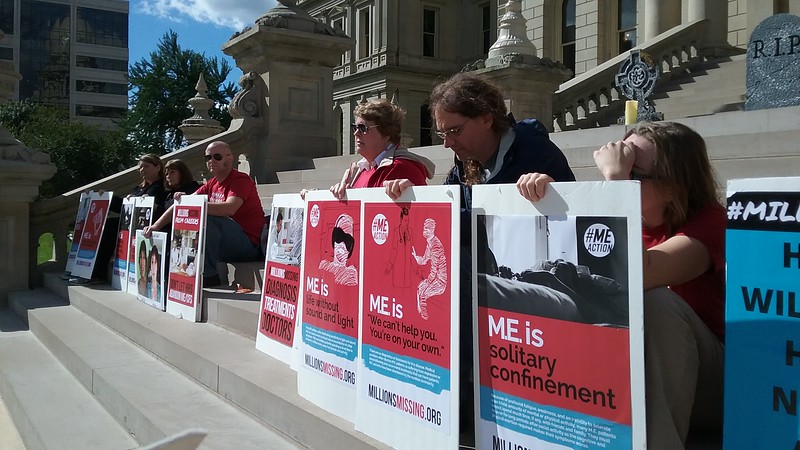
First published on ProHealth as "You Are Not Alone." One of the harshest punishments that CFS/ME inflicts upon its sufferers is isolation. Human beings are social animals, and we do poorly when placed in situations that remove us from contact with other people. Isolation is not the same as loneliness. Loneliness is an emotional state, the result of feeling alone, even when other people are present. Isolation is a state of being prevented from interacting with other people. The distinction between the two terms may appear to be a fine point, but the crucial difference is that isolation is usually imposed upon us. Of course, there are those who voluntarily remove themselves from society, but these people – recluses – usually are content with their state of separation from the world. Why? Because they have chosen it. When people don’t choose to be isolated, when it is forced upon them by circumstances beyond their control, it is unbearable. This is why solitary confinement is the ultimate punishment for inmates in prisons. It puts people in a state of complete helplessness. The Center for Constitutional Rights considers solitary confinement to be a form of torture – a violation of the Eighth Amendment’s prohibition of “cruel and unusual punishment.” Prisoners who are placed in solitary confinement, even for a few weeks, experience “increased anxiety, nervousness, headaches, nightmares, fatigue, obsessive ruminations, confused thought processes, mood swings, depression, memory lapses, confusion, problems with impulse control, paranoia, feelings of overall deterioration, and thoughts of suicide.” These prisoners, by and large, were healthy before being placed in solitary confinement. Imagine how this type of isolation would affect a population that is ill. People with CFS/ME don’t have to imagine the consequences of solitary confinement on an ill population. Those who are severely ill experience the torture of solitary confinement on a daily basis. The four walls of a bedroom, for months, years on end, can feel exactly like a prison cell. In effect, it is no different from a prison. Whether your jailer is the judicial system, or the unpredictability of an illness, the result is the same. Much like prisoners in a penitentiary, people with CFS/ME feel themselves to be stigmatized, rejected by society, ignored, dismissed, unable to fit in. Even among those who can get out and about, CFS/ME is profoundly isolating. The illness is their “dirty little secret,” something they can’t talk about for fear of being labeled as “defective.” When they do dare to bring up the topic, they inevitably become objects of misplaced advice (“You should work out!”), psychologizing (“Were you abused as a child?”), false sympathy (“I’m tired, too…”), and all the other well-intentioned but ultimately distressing comments that anyone with CFS/ME dreads having to respond to. If you combine this social minefield with the physical limitations imposed by CFS/ME, and then add the very real fear that the illness will result in the loss of a job, or a spouse, or friends, the isolation becomes complete, for now it exists not just in daily life, but projects itself into the foreseeable future ... for all time. Breaking the Chains of Isolation According to Dan Moricoli, founder of the ME-CFS Knowledge Center, there are 24 million with CFS/ME worldwide. Other estimates place that number at a more conservative 17 million, but any way you look at it that’s a lot of people. It’s also cold comfort. Simply knowing that a lot of other people have this illness can’t help you break out of solitary confinement - or can it? The fact that so many people are experiencing – right this very moment – exactly what you are going through is not a comfort unless you also realize that they, like you, are seeking break the bonds of isolation. They are tapping a code on the walls of their cells, hoping someone will answer. Tap back and you may find that with the right co-conspirators, you will be able to tunnel your way out of jail. These are some of the ways people with CFS/ME have connected with one another. Support groups: Back in the day when dinosaurs roamed the earth, support groups used to meet in person. There still are support groups that have regular face-to-face meetings. But there are also a slew of groups that meet online. How do you find one? You can simply type in the words “facebook” and “chronic fatigue” into a google search. Many support groups not only have Facebook pages, but websites. State and national CFS/ME organizations also keep lists. Find these organizations HERE. Buddies: Having a buddy to talk can be a real lifesaver. A CFS/ME buddy is someone who is also ill, and who you can compare symptoms with (“I have this strange prickling feeling in my feet. Have you ever had that?”), who you can talk about treatments with (“Have you tried D-Ribose?”), who you can commiserate with (I’m having a bad day), or celebrate with (“I’m having a good day!”), and someone with whom you can simply feel as if you don’t have to keep up appearances. Just one person who really gets it can make a huge difference. (And that person could be you!) You can often find a buddy through a support group or meet-up. But sometimes they just appear, like ports in a storm. Once you start looking for friendship, it comes knocking. Forums: There are several excellent, longstanding forums where people come to exchange ideas, talk about the latest news, chat, and generally feel welcomed into a community: ProHealth, Phoenix Rising, Hawkes’ Health Forum, Not Crazy, ME-CFS Community, and ME/CFS Forums are among the best. Forums are great because they are organized into topics, which allows you to focus on whatever area interests you. Yahoo Groups: It is surprising how many yahoo groups there are for people with ME/CFS. If you do a google search on “Yahoo Groups” then, once you are in the directory, type in “chronic fatigue” or “Myalgic Encephalomyelitis” in the “Find a Yahoo Group” bar, dozens of groups will pop up. Many of these groups are local, that is they are meant for people who live in a specific city or region. Yahoo groups are not just a good way to connect with people, they keep you informed about the latest news in the CFS/ME community. Meet-ups: Meet-ups are local social groups that share a common interest. Like old-fashioned support groups, meet-ups get together in person. There are 115 CFS/ME meet-ups in 8 countries. Blogs: ME/CFS Blogroll is a list of over 300 CFS/ME blogs started by Elisa, a longtime ME/CFS advocate. In her words, “It helps with the isolation - to "hear" all our voices and views and it gives me hope to find help... and to feel better, some day!” I couldn’t agree more. It is very liberating to read a blog post that expresses precisely how you feel. What’s more, you can always leave a comment, or start a blog yourself. Expression is a safety valve for the frustrations of “down time.” Helplines: Many CFS/ME organizations provide helplines. These are usually staffed by volunteers and are meant to help people with CFS/ME find support groups, local physicians who may be receptive to patients with CFS/ME, legal help for obtaining disability, and other sorts of assistance. Although much of this information can be found online, it is nice to talk to a person who is helpful and sympathetic.
Don’t give up on finding fellow inmates! You are not alone.
Invest in ME is an independent UK charity campaigning for bio-medical research into Myalgic Encephalomyelitis (ME) (Between 150,000 and 250,000 people in the UK have ME.) This is a fairly new charity, but they have a big vision: to implement a national strategy in the UK to advance biomedical research into the causes, pathology and epidemiology of ME, eventually leading to biomarkers, medical treatments, and a cure.
To further that goal, Invest in ME hosts an annual international conference featuring clinicians and researchers from all over the world, as well as international patient advocacy groups and journalists. This year’s conference will be held on May 31 in London and includes Sonya Marshall-Gradisnik of Bond University; Prof. Olav Mella and Dr Oystein Fluge of the Norwegian Rituximab study; Dr Andreas Kogelnik of the Open Medicine Institute and Dr Mady Hornig. Invest in ME is also raising funds to establish a UK and European Centre of Excellence for translational biomedical ME research. The center would not only focus on research, but would include a strong clinical component, diagnosing and treating for patients, as well as training healthcare providers. Invest in ME has already raised $244,400 of the $255,000 they will need to start their first research project.
Please vote now to help raise funds for this worthy charity. Voting ends on April 30th.
You can only vote once! Go HERE to vote.
Click HERE and then click "rank" to see how Invest in ME is doing.UPDATE: Thanks to everyone who voted! Invest in ME won 2,000 pounds!
This article was reprinted from Tokyo Web April 9, 2013
Translation courtesy Paul Doyan of the Microwave Factor April 11, 2013
Unexplained fever, followed by weakness, multiple symptoms in the prime of life: Chronic Fatigue Syndrome
Tokyo Web, April 9, 2013
Suddenly one day, she was overcome by a sense of systemic malaise, fatigue followed by low-grade fever -- i.e. "chronic fatigue syndrome" (CFS). While there are many cases developing from one`s twenties to one`s forties, in the prime of life, the exact cause is unknown and there is no simple treatment. Diagnosis is difficult and the symptoms are similar to depression. There are also doctors who do not know or will not acknowledge the disease, and patients get passed around by general practitioners and psychiatrists. (Akiko Hosokawa)
Something happened inside the body of a woman (40) in Tokyo in March of 2009. She broke out in a fever of 39 degrees and hence took anti-fever medication, but a low-grade fever continued to last for more than a week. She fell into a brain fog and could not understand the content of conversations while the slightest of movements left her breathless. Gradually, general muscle strength became so weak, she was not even able to grasp the pots on the stove. She was treated, but there was no alleviation of symptoms, and she was diagnosed with CFS six months later.
She is a single mother, with a daughter (12) in junior high school and a son (10) in elementary school. Since August of 2010 she has been on leave from work but the low-grade fever and headache still continue. She is almost completely bedridden and gets around in an electric wheelchair. Her children prepare her meals and take care of her. She says she feels a little better when taking Chinese medicine and or when receiving a massage to increase blood circulation. "Since I am able to move around as I would like, I think I will be leaving my children with some bitter memories."
"Many CFS patients are in their twenties to forties with a good percentage of these being women," points out CFS leading authority Kansai University of Welfare Sciences Professor KURATSUNE Akihiko. He guesstimates there are over three hundred thousand patients in Japan.
CFS is distinguished by a sense of languor and weakness, followed by a low-grade fever, and muscle and joint pain. While diagnostic criteria is based on such things as this continuing for more than six months and disrupting daily life, a number of doctors also base it on the patient having swollen lymph nodes. In some cases, when a general examination finds no abnormalities it is suspected the patient is feigning the illness. One women with a sudden worsening of symptoms ran to the local clinic and when she mentioned CFS she was told that "CFS can not be diagnosed or treated."
Many patients also complain of symptoms besides the physical symptoms, such as insomnia and a reduction in concentration and the ability to think. INOUE Michichika of the "Ikebukuro Clinic" in Ikebukuro, Tokyo states, "It is difficult to distinguish between depression, and often patients wander from hospital to hospital." Since the symptoms overlap between psychiatry and internal medicine, it is important to have the cooperation of both here.
While it is not clear what causes the onset of symptoms, when patients' blood is examined, there are cases where some sort of virus is found and KURATSUNE points out that there must be some connection with the immune system.
One distinguishing factor found in patients' blood is a higher than normal presence of reactive oxygen species and sometimes medicines are prescribed which lowers the amount of these.
However, at present, there are only specific treatments available to alleviate each symptom. And while some patients return to a normal everyday life, there are others who suffer for more than ten years without an alleviation of symptoms.
A study group with the Ministry of Health, Labour and Welfare, in which KURATSUNE is participating, is making advances in diagnostic criteria like checking the pulse from the fingertip to determine autonomic system balance. Kuratsune states "If you feel tired, take a rest, and if that does not help, then see a specialist."
◆ Outside the Scope of Welfare Services
Some CFS patients whose symptoms become severe end up bedridden and require assistance to eat and to go out. However, if their symptoms are not constant, then it is difficult for them to get disability benefits.
In the Comprehensive Welfare Act for Persons with Disabilities set to take effect in April, patients with intractable diseases who do not have a disability will also be able to receive welfare services such as aid payment and housework assistance. However, CFS is excluded.
Dr. SHIN Isu of the Sekimachi Medical Clinic in Nerima-ku, Tokyo, points out that "The word 'Fatigue' in the disease name does not reflect the actual conditions. It invites misunderstanding and this is one factor as to why these people cannot receive social security benefits."
It is said that some doctors in Canada and the United Kingdom advocate a name change to "Myalgic Encephalomyelitis" because there are such things as inflammation of the brain, etc. in critically ill patients. Dr. Shin also agrees with a name change. He states, "I would like for the critically ill to be able to receive welfare services on a priority basis."
On April 24th, after 22 years of serving as the head of the CFIDS Association of America, Kim McCleary announced her resignation for family reasons. In a touching and, at times, tearful video statement (see below), McCleary stated that her term would be ending in June. McCleary will stay on as an active member of the Association’s Scientific Advisory Board.
McCleary’s term as president and CEO of the CFIDS Association of America began in 1991. During her tenure, McCleary shifted the focus of the organization toward research, policy, and education issues. Her goal was to obtain recognition for ME/CFS as a disabling condition, and to influence policy at the national level.
Under her leadership, the Association played an integral part in developing a policy ruling for the Social Security Administration that recognized CFS as a disabling condition. She fought to create and sustain a dedicated federal advisory committee to the Secretary of Health and Human Services on ME/CFS research and education, and helped expose the misappropriation of $12.9 million in CDC spending, restoring these funds to ME/CFS research. McCleary led the first-ever public awareness campaign for ME/CFS, led lobbying events, organized Congressional briefings and delivered testimony at numerous federal hearings and meetings.
McCleary’s strong personal attachment to the ME/CFS community was evident during her resignation speech, during which she listed the accomplishments of the Association, and expressed her commitment to create a world without ME/CFS. In a voice choked with emotion, she lauded the struggles of “family members, parents, spouses, brothers, sisters, sons, daughters who resolve to battle for their loved ones, and all people affected by ME/CFS.” Through tears, McCleary said, “I look forward to watching progress in the days ahead and to celebrating with you when effective treatments and cures return every person living with ME/CFS to lives they dream of living again.”
We look forward to that day as well, and, when it comes, we hope to celebrate it with Kim McCleary.
Transcript
“Hi, I’m Kim McCleary president and CEO of the CFIDS Association of America. In 1991 I joined the CFIDS Association and this community as the organization’s first chief staff executive. When I came to this organization, I could not have envisioned all the ways in which my work would become my life and how the people I would meet would shape and redefine me. I’ve been honored to partner with thousands of volunteers, nearly a hundred board members, fifty staff members, seven chairmen, and founder, Mark Iverson, to advance our mission. I will always be a vocal champion for this organization and its vision of a world without ME/CFS.
Over the past 22 years I have been part of some incredible work, the drug development and patient focus workshop that FDA will host later this week, launching the world’s first patient-centered virtual institute for ME/CFS, the Research Institute Without Walls, and dozens of events, live and over the web that gave voice to thousands of people with ME/CFS.
I’ve come to know some of these amazing people personally. People who face this uncertain, chronic, debilitating condition with a brand of courage and optimism I don’t think I could muster or sustain: family members, parents, spouses, brothers, sisters, sons, daughters, who resolve to battle for their loved ones, and all people affected by ME/CFS. Each and every person I’ve met through the vital work of this organization has touched my life in ways I’ll carry with me lifelong. Along with my family I will be relocating in June, and it is time to write a new chapter. The vision is clear. The path is laid out before us.
Over the past several months the leadership team has worked together to develop an incredibly strong strategic plan that is already changing the landscape for ME/CFS research to accelerate the path for safe and effective treatments. There is an amazing team in place that will execute that plan and make it reality for you. I pledge my continued dedication through the end of my term in June, and then I will proudly serve as an active member of the Association’s Scientific Advisory Board, so that our work together will not end.
My personal connection to this community will endure and leave a lasting impression on my life. I humbly thank you for the years you have entrusted me to steward this fine organization. I look forward to watching progress in the days ahead and to celebrating with you when effective treatments and cures return every person living with ME/CFS to lives they dream of living again."
 ME/CFS Awareness All Fall Down for M.E, 2.30 to 3PM, Sunday. May 12th, Westminster To commemorate international ME/CFS Awareness Day, and to draw media attention to the plight of people suffering from ME/CFS, All Fall Down for M.E. is holding a lie-in across from the House of Commons in London, UK, on May 12, at 2:30 PM. All Fall Down for M.E. is a cross-charity event with no particular charity affiliations, although we particularly support those which promote and fund biomedical research
Disclaimer: Please note that everyone taking part in this event is responsible for their own safety and wellbeing; the organisers do not take responsibility. The police have been informed and since this is public land they have assured us we have the right to demonstrate here, they will support us and that there is no risk of arrest – unless someone does anything that is likely to endanger the health & safety of others. While collapsed, we need to show that this is not enjoyable: the person with ME has to do this in order to survive/exist. We suggest you bring a black sheet/cloth/bin bag to cover your body to signify a living death. Please bring props such as eyemasks, sunglasses, ear defenders, possibly feeding tubes etc to convey: The exhaustion to the point of collapse after minimal activity; the nerve, joint and muscle pain unresponsive to painkillers; the physical weakness; the cognitive dysfunction with thinking & memory problems; the inability to tolerate light and noise; the faintness & dizziness particularly when standing; nausea; rest or sleep bringing little or no relief; plus many other symptoms. This is what our loved ones have to suffer, day after day, after month, after year, with no end in sight. A living death. Since Old Palace Yard is cobbled, you may also wish to bring something to lie on, but please make it as ‘dead-looking’ as possible i.e. no bright colours. Please bring banners if you wish but think about who may hold them while you are lying on the ground. We plan to have those with banners at the back, with those collapsed on the ground in front of them. We plan to film & photograph the event from an angle that gives maximum impact to the sight of those collapsed on the ground, with the Houses of Parliament in the background. Ideas for straplines: M.E – a living death, it could be YOU or your child. Biomedical Research urgent. You may want to wear a sash or sign saying, for example: My son, M.E 6 years; my wife M.E 20 years; my Dad M.E …; my sister….and so on. Our aims are: to raise awareness among the public and government about how severe & long-lasting M.E can be; how common it is; how it can strike healthy, happy individuals out of the blue, particularly our children and young people; and that we urgently need far more investment in biomedical research to discover cause(s), effective treatments and hopefully a cure – before it’s too late. We also need far better training for doctors etc. on the latest knowledge about M.E. With this demonstration, as well as depicting the severity of the illness, we will be honouring those who have actually died from M.E. and also the courage of all those who continue to fight on in the hope of a living life.
|